AI TOOL / #06659
PrettyPolly
An AI-based language learning platform designed for practicing foreign language speaking skills.
Introduction
AI language learning platform for practicing speaking foreign languages.
What is PrettyPolly?
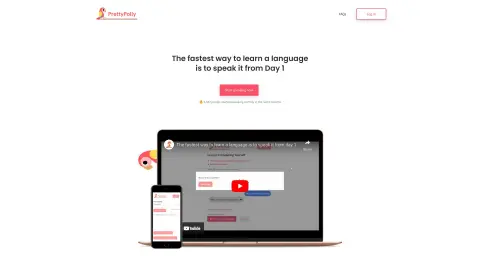
PrettyPolly is an artificial intelligence-based language learning platform that allows users to practice speaking a foreign language through conversations with AI. It provides personalized feedback and fluency assessments to help users track their progress. The platform is designed to make language learning more convenient and effective by enabling users to start practicing speaking from the very first day.
How to use PrettyPolly?
By using PrettyPolly, users can initiate conversations with the AI, select a language of their choice, and speak via microphone. The AI will respond, enabling interactive practice. Users can save their conversations to check their fluency scores and receive personalized feedback. Premium members enjoy unlimited conversation opportunities.
The core features of PrettyPolly
AI-based language dialogue practice
Fluency scoring tracking
Personalized feedback
Provide lexical support for translation.
Dialogue prompts generated by AI
Integration with Anki’s spaced repetition system
Related
Douban Reading
Book rating and reviews
Chrome App Store
Google Chrome extensions
Beginner Tutorial
Programming Introduction Tutorial
Steam
game platform
IvyCraft AI content generation platform
IvyCraft is an AI content generation platform. Upload existing data such as PDF, Word, and web pages to generate PPT, infographics, podcasts, and videos based on the original content. It also supports the creation of comics, picture books, and social media content. The generated PPT and infographic can be continued
Ask Academic-Academic Edition codex
Programmers have been completely changed by Codex. Instead of typing out code line by line, they can throw requirements to AI and let it write code, run tests, fix bugs, and deliver in a closed-loop. So here comes the question: isn’t the work that scientific researchers do every day “configuring environments, running experiments, copying codes, and checking